How to Use This Tool
- Count the bands and establish the reading direction.
- Select each colour in order from the first significant digit.
- Read resistance, tolerance and the six-band temperature coefficient separately.
Calculation Method
Count the painted bands before choosing a mode. A four-band resistor has two significant digits, a multiplier and a tolerance band. Five bands use three significant digits before the multiplier and tolerance. A six-band marking adds a temperature coefficient. The body colour is not a resistance digit.
Worked Example
Yellow, violet, red and gold reads 47 × 100 = 4,700 Ω, or 4.7 kΩ, with ±5% tolerance. Five percent of 4,700 Ω is 235 Ω, so the nominal tolerance interval is 4,465 to 4,935 Ω. The multiplier does not add two zeros to the tolerance percentage.
Establish the Reading Direction
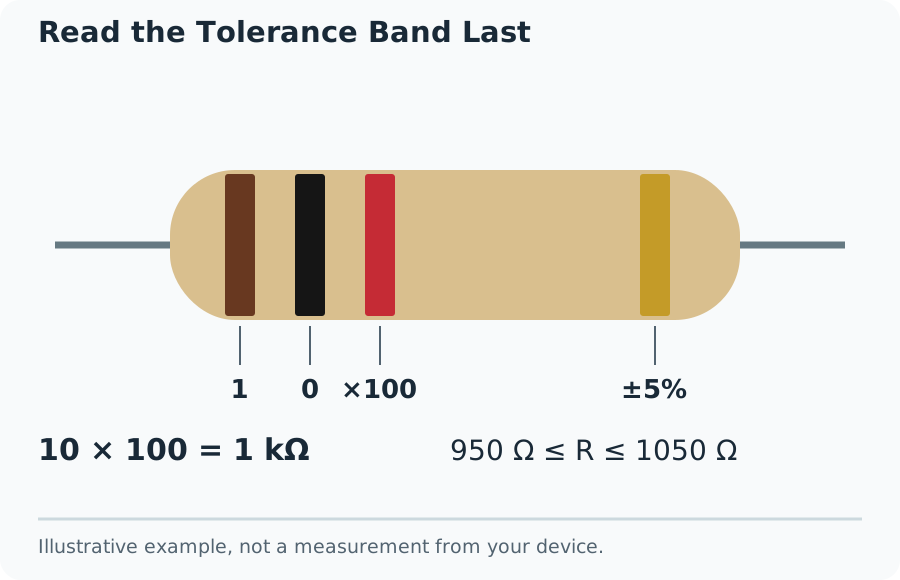
A tolerance band may be separated from the others and is often near one end, but spacing and paint are not always clear. Gold or silver cannot be a significant digit. Inspect both directions in good light and check the component documentation when a worn or unusual marking remains ambiguous.
Read the Tolerance Band Last
Separate Digits from the Multiplier
Colour meaning depends on position. Red used as a digit means 2, while red in the multiplier position means multiply by 100. Gold and silver represent fractional multipliers and can also mark tolerance. Select colours by position rather than reading every band as another digit. An unavailable selection means that colour is not supported in that role.
Check a Four-Band Example
For a five-band example, brown, black, black, red and brown reads 100 × 100 = 10,000 Ω at ±1%. The interval is 9,900 to 10,100 Ω. Adding a sixth temperature band does not change those first five positions.
Interpret Tolerance and Temperature Coefficient
Tolerance describes the permitted difference from nominal resistance under the component’s specified conditions. It is not the resolution of a multimeter and does not include every possible effect of temperature, ageing or circuit loading. A six-band temperature coefficient is expressed in ppm/°C. For example, 100 ppm/°C corresponds to 0.01% per degree, subject to the manufacturer’s stated conditions.
A colour code does not identify the resistor’s wattage, voltage rating, construction or safety approval. Two parts with the same resistance and tolerance may have different permitted uses. Read the datasheet before choosing a replacement for a power, mains or safety-related circuit.
The default color convention follows the verified IEC 60062:2016 table. Gray tolerance is ±0.01% there; some older manufacturer charts use gray for ±0.05%. Check the actual part documentation before accepting an ambiguous precision marking. A missing tolerance band represents ±20% in the three-band convention, rather than an extra painted color.
Compare with a Resistance Measurement
Disconnect the circuit’s power and use an appropriate procedure before measuring resistance. Other components in a connected circuit can provide parallel paths and change the reading. A code decoder explains the nominal marking; it cannot distinguish a damaged resistor from a measurement affected by the surrounding circuit.
What the Result Means
This page covers supported four-, five- and six-band axial resistor markings. It does not read colours from a photograph, decode every SMD marking, or identify inductors and capacitors with similar-looking bands. Printed text, special-purpose bands and manufacturer-specific markings require the relevant part documentation.
Common Questions
Why Does a Gray Tolerance Band Differ Between Charts?
This tool follows the supported IEC 60062:2016 table, where gray tolerance is ±0.01%. Some older manufacturer charts use another value. Identify the part and follow its data sheet when the marking convention differs.
How Do I Choose the Reading Direction?
Find the tolerance band and the spacing around it, then read significant digits from the other end. Similar spacing or unusual markings can remain ambiguous. Confirm the part documentation rather than accepting whichever direction gives a plausible number.