How to Use This Tool
- Copy the IP rating from the manufacturer’s specification for the exact model.
- Type the complete supported code in the IP-code field, including IP and both positions.
- Read both meanings and consult the manufacturer’s stated conditions, including depth and duration where relevant.
Calculation Method
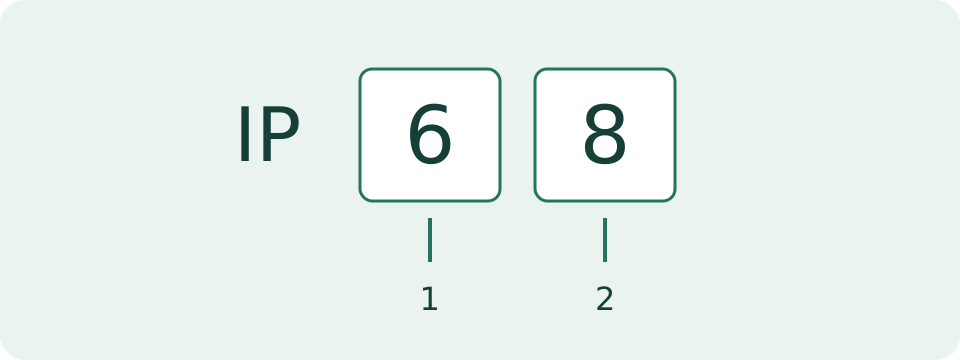
The first position describes solid-object or dust protection. The second describes a water test category. X means no degree is specified for that position; 0 specifies no protection. Each position is interpreted separately, without inferring unlisted tests.
Worked Example
IP68 combines dust-tight protection with water category 8 under specified immersion conditions. IPX4 declares splash protection but leaves the solid-object degree unspecified. Neither code alone establishes a water-jet rating.
Enter the Exact Declared Code
Copy the rating from the manufacturer's specification for the exact model and assembled configuration. Type the whole supported code, such as IP54, IP68 or IPX4, into the input. The lookup separates the solid and water positions. It does not contact a certification database, examine an enclosure or test the seals of the device beside you.
This page accepts the letters IP followed by two supported positions. The first is X or 0 through 6; the second is X or 0 through 9. Lowercase letters and spaces at the ends are normalized. Additional letters, K suffixes and a pair of digits without IP are unsupported rather than silently reinterpreted.
Keep the Two Positions Separate
IP54 has solid position 5 and water position 4. The first describes dust protection with limited entry that must not cause harmful effects under the relevant conditions. The second describes water splashes from all directions. Combining the two does not turn the enclosure into a universally sealed container. Each position has its own meaning and test conditions.
IP68 combines dust-tight classification with water category 8. The water result still needs the manufacturer's specified immersion conditions. IPX4 leaves the solid degree unspecified while declaring the splash category. The example table shows these fields separately so a missing statement in one position cannot be mistaken for protection inferred from the other.
| IP | Solid position | Water position |
|---|---|---|
| IP54 | Dust protected; limited non-harmful dust entry permitted | Water splashes from all directions |
| IP68 | Dust tight | Immersion under manufacturer-specified conditions |
| IPX4 | No solid-protection degree specified | Water splashes from all directions |
| IPX0 | No solid-protection degree specified | No water protection |
| IP0X | No solid-object protection | No water-protection degree specified |
| IPXX | No solid-protection degree specified | No water-protection degree specified |
Distinguish X from Zero
X means that a degree is not specified for that position. It is not proof that no testing ever took place, and it does not give a numerical protection level. Zero states no protection for that category. IPX0 and IP0X therefore express different combinations: unspecified solids with no water protection, or no solid protection with unspecified water protection.
IPXX is accepted as two unspecified degrees. The result contains no positive protection claim. Do not replace an unknown character with zero to make a code fit. Preserve the manufacturer's original wording in a note and check the relevant specification. A shop headline saying water resistant without an exact code supplies too little information for this lookup.
Do Not Rank Every Water Category as a Ladder
Water jets and immersion apply different physical effects. An immersion declaration at category 7 or 8 does not automatically establish a category 5 or 6 jet result. Category 9 also cannot be used as a shortcut to all the lower water tests. A device may declare more than one rating to describe separate tested conditions.
Read each declared code individually and retain the associated conditions. This tool does not accept a combined string such as IP66/IP68; look up each supported code separately. Do not add the digits, average them or choose the larger number as a complete substitute. The decoded category explains a declaration, not a recommendation to reproduce the laboratory exposure.
Check Conditions Beyond the Short Code
For water category 8, look for the exact model's stated depth, duration and restrictions. The code alone supplies no universal depth or indefinite-use permission. The enclosure configuration can also matter: covers, connectors, installed accessories and the condition of sealing parts should match the manufacturer's instructions. A rating for one component does not establish the same rating for the assembled system.
The lookup does not assess corrosion, impact, age, repair quality or resistance to every liquid. A stored product rating is different from the present condition of an individual unit. Device exposure and warranty questions belong with the manufacturer's current product instructions. No result here verifies continued performance after wear or damage.
Handle Suffixes and Other Rating Systems Honestly
IEC water category 9 and the ISO 9K classification have different standard requirements. IP69K and IPX9K are not interpreted by this two-position tool. An unsupported result does not declare the manufacturer's code invalid; it means the code is outside the supported scope. Do not delete K or any supplementary letter merely to obtain a result.
NEMA enclosure types are another classification system and cannot be reduced to this lookup's two digits as a universal conversion. IP here means ingress protection, not an internet protocol address. Keep a useful record containing the manufacturer URL, exact model, complete original rating, cited standard and any stated conditions. That record is more informative than a screenshot containing only a large IP number.
What the Result Means
The lookup does not verify certification, seal condition, warranty coverage or resistance to every liquid. IPX8 conditions depend on the manufacturer. Immersion ratings do not automatically include water-jet tests. Unknown digits, letters and suffixes remain unsupported.
Common Questions
Does IP68 Mean Any Depth or Duration Is Allowed?
No. Read the exact model’s immersion conditions and use limits. An IP code is a test classification, not permission for unrestricted submersion.
Are IPX9 and IPX9K the Same?
No. IEC water category 9 and the ISO 9K test have distinct requirements. This two-position lookup does not interpret K suffixes.