How to Use This Tool
- Read the pack capacity in mAh and its documented charge C-rate.
- Enter nominal pack voltage from the label, not a charger voltage setting.
- Compare the calculated current with the battery and charger instructions.
Calculation Method
Current A = capacity mAh ÷ 1000 × charge C-rate. Nominal reference W = nominal V × A. Ideal constant-current equivalent hours = 1 ÷ C.
Worked Example
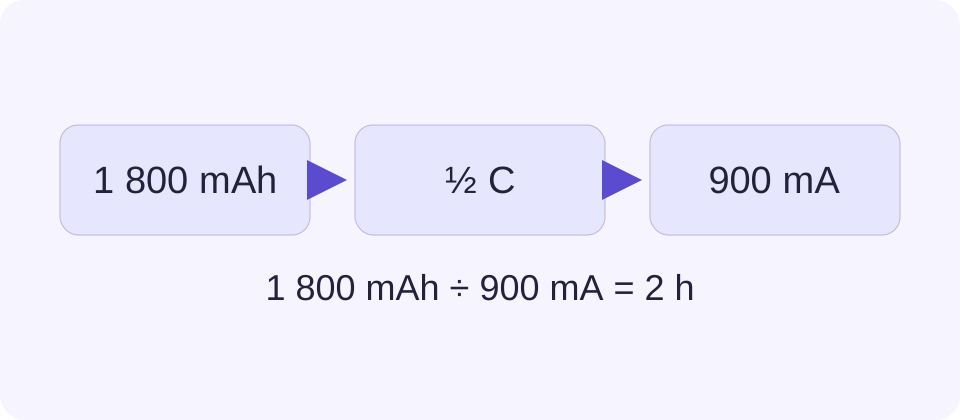
An 1800 mAh pack at a documented 0.5C gives 0.9 A. At 14.8 V nominal the reference is 13.32 W; the ideal equivalent time is 120 minutes.
Choose the Charge Rating, Not the Discharge Rating
The charge C-rate describes current relative to the capacity of one pack. Convert mAh to Ah before multiplying. An 1800 mAh label means 1.8 Ah, so an entered 0.5C produces 0.9 A. The calculator applies the entered multiplier; it does not choose a suitable multiplier for the battery.
A prominent 50C or 100C marking commonly describes discharge capability. That number cannot be reused as a charging instruction. Find the charge-rate wording in the exact battery manual or product specification. An unclear label is missing information, not a reason to try the larger number. No universal charge rate is certified by this page.
Read the Three Results Separately
The current result is a conversion in amperes. The nominal power result multiplies that current by the pack voltage entered here. Nominal voltage is a reference for the pack, not the voltage that a compatible charger uses throughout its charging cycle. Chemistry and cell count determine the required charging program, and those settings must come from the product instructions.
A charger must satisfy both its current and power limits under the actual charging conditions. A nominal 13.32 W result does not establish that a 14 W charger will support the requested current until completion. Shared power between channels and the charger power supply can impose further limits. This tool has no connection to the charger and cannot validate those limits.
Check an Example Without Changing the Battery Rules
For an arithmetic example, use 1800 mAh, 0.5C and 14.8 V nominal. Capacity is 1800 ÷ 1000 = 1.8 Ah. Current is 1.8 × 0.5 = 0.9 A. Nominal reference power is 14.8 × 0.9 = 13.32 W. The equivalent constant-current time is 1 ÷ 0.5 = 2 hours, or 120 minutes.
Changing only the entered multiplier changes current proportionally. The rows below demonstrate that relationship, without authorizing any row for a particular pack. Keep the pack capacity fixed when comparing C-rates; adding the capacities of unrelated spare batteries would calculate a different electrical arrangement.
| Capacity | Entered Charge Rate | Current | Ideal Equivalent Time |
|---|---|---|---|
| 1800 mAh | 0.5C | 0.9 A | 120 min |
| 4000 mAh | 1C | 4 A | 60 min |
| 2500 mAh | 2C | 5 A | 30 min |
Why the Time Reference Is Not a Countdown
The expression 1 ÷ C assumes a full capacity quantity delivered at one unchanging current. It contains no starting state of charge, measured cell voltage, balancing current or end-of-charge rule. A partially charged pack does not need its full nominal capacity returned. During a real charging cycle, current can also fall before charging ends.
Treat the time as a unit check. A 0.5C input produces a two-hour equivalent; a 2C input produces half an hour. Neither number is a promise that the charger will finish then. Leave the charging-complete decision to compatible equipment operating according to its manual, and monitor the process as directed by the manufacturer.
Resolve Mismatches Before Using the Result
A result one thousand times too large usually means Ah was entered into the mAh field incorrectly, or a conversion was applied twice. For a 4 Ah pack enter 4000 mAh. Check decimal separators and units, then compare the numerical current with the documented charging limit.
Damaged, swollen, wet or otherwise unsuitable packs cannot be made suitable by selecting a lower C-rate here. The battery instructions govern inspection, temperature, balancing and charging location. This calculator is an arithmetic aid, not an electrical test. For a general capacity-and-power time model, use the charging-time calculator and read its separate assumptions.
Charger adjustment steps can be coarser than the calculated number. A result such as 0.9 A is not permission to round upward to the next setting. Compare the available settings with the documented limit and the charger instructions. The tool does not know the available adjustment steps. Retain enough digits during the conversion to avoid a unit or rounding mistake.
What the Result Means
This arithmetic does not approve a charge rate, identify chemistry, set charging voltage, inspect a pack or predict full-charge duration. Use the battery and charger manuals.
Common Questions
Is the Large C Number on My Pack the Charge Rate?
It may be the discharge rating. Use the value explicitly identified as the permitted charging rate in the product documentation.
Does 1C Always Finish in One Hour?
No. One hour is the ideal constant-current equivalent. Current taper, cell balancing, starting charge and charger limits change the actual duration.