How to Use This Tool
- Choose one currency and enter the replacement supply cost.
- Enter the corresponding declared page yield, using the same page format and print mode.
- Add paper cost per printed page, or leave it at zero for an ink/toner-only calculation.
Calculation Method
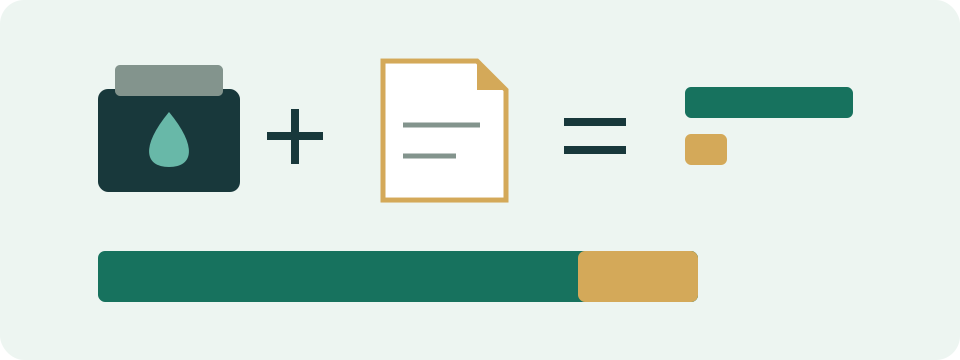
Cost per page = replacement cost ÷ declared yield + paper cost per page. Multiply this by 100 for the 100-page estimate. Retain fractional currency amounts during the calculation.
Worked Example
Example cost 40 divided by a yield of 2,000 pages gives 0.020 per page. Adding paper at 0.005 gives 0.025 per page and 2.50 per 100 pages in the selected currency.
Match the Replacement Price to the Declared Yield
Identify the exact cartridge, bottle or other supply, its replacement version and the documented printer or test method. Keep that identity with the price and date. A standard cartridge price beside a high-yield cartridge's page count is an incompatible pair even when both fit the same printer. A price for a complete colour set also needs a corresponding yield basis, not a convenient figure for one unrelated cartridge.
Enter the replacement price in the selected currency and the matching declared page yield. The form has no cartridge database, live price, print-mode selector or automatic compatibility lookup. A stated yield is a reference from its documented method, not a measurement of your pages. Keep observed use separate from the declared figure so a change in basis does not masquerade as a better result.
Read the Output in Currency Units Before Converting to Cents
A hypothetical supply costing 54 with declared yield 2400 gives 54 ÷ 2400 =0.0225 currency units per page. Paper at 0.012 per printed page brings the total to 0.0345. The 100-page output is 3.45. A separate hypothetical 108 supply with matching 6000-page yield gives 0.018 before paper and 0.03 after that same paper assumption. These examples are arithmetic, not quoted supply prices.
The first total is 3.45 cents per page in a currency with 100 cents per unit, not 0.0345 cents. Keep fractional amounts until the final total. Rounding 0.0345 to 0.03 before multiplying by 100 understates 3.45 as 3.00. The interface shows the selected currency's amount with additional decimals; changing the currency label never performs an exchange-rate conversion.
| Supply cost | Declared pages | Supply/page | Paper/page | Total/page | Total/100 pages |
|---|---|---|---|---|---|
| 54 | 2400 | 0.0225 | 0.012 | 0.0345 | 3.45 |
| 108 | 6000 | 0.018 | 0.012 | 0.03 | 3 |
Use the Documented Method Instead of a Blanket Coverage Rule
Epson distinguishes document cartridge, pack, bottle and photo-yield methods. Its document cartridge explanation refers to controlled continuous printing and specific patterns. Brother's monochrome toner reference also describes controlled conditions and variable actual use. Those documents do not justify treating every declared yield as the same simple 5% page or multiplying every result by a universal real-world factor.
Content, print settings and usage can change actual consumption. This tool has no page-coverage field, measured-yield adjustment or hidden multiplier. Its output remains the cost/yield reference you supplied. A difference from an actual session is a reason to compare method and input meanings. It does not prove a defective cartridge, an exact remaining yield or a guaranteed future job cost.
A Printed Page Is One Printed Side
A sheet with two printed sides contains two printed pages. The paper field is already a cost per printed side, not a pack price. A hypothetical 7.50 pack of 500 sheets costs 0.015 per sheet. For 100 printed sides on 50 sheets, its allocated paper cost is 0.0075 per side. Compute that allocation before entry; the form has no sheet-count or duplex controls.
Odd page counts can use an extra sheet. For 101 printed sides on 51 sheets, paper allocation is 51 × 0.015 ÷ 101, approximately 0.007574257 per side. Actual blank pages, inserts and wasted sheets can also change the allocation. Printing both sides does not halve ink or toner use merely because the sides share paper. Zero paper excludes its cost from this model rather than claiming paper is free.
Colour Yields Are Not Independent Piles of Extra Pages
Several colours may contribute to the same document pages. Do not add their yields as if each supplied additional independent pages. A price for several supplies needs an explained matching yield or separately documented consumption basis. The single cost/yield field cannot reconstruct the full per-colour usage of an arbitrary document. Read the manufacturer's definition of colour or composite yield for that product.
Initial and replacement supplies can have different documented methods or startup allocations. The actual source must identify which figure is used; a generic rule that every included supply has the same reduced yield is inadequate. Hardware cost, electricity, service, separate maintenance parts and wasted work are not additional fields here. Keep these exclusions visible rather than treating the consumables subtotal as the entire cost of owning the printer.
Validate Inputs and Keep Quality Checks Separate
Supply and paper costs may be zero or positive; yield must be positive and finite. Zero or negative yield is rejected instead of producing a price. Enter ungrouped numbers such as 2400, with a decimal point in English or the accepted local decimal separator. Blank optional paper is treated as zero. A missing required supply cost is incomplete rather than an automatically free cartridge.
Use the result to check one compatible cost/yield scenario and compare a separately labelled alternative. It does not choose a printer or calculate a custom page-count job total. A printable test page can support a separate visual check of output patterns, but it cannot verify declared yield or calibrate colour. The numerical reference and the physical output observation answer different questions.
What the Result Means
Declared yield is a test reference, not measured consumption for your job. Coverage, maintenance and usage affect actual yield. Hardware, electricity and service costs are excluded.
Common Questions
Can I Add Individual Colour-Cartridge Yields?
Not blindly. Match the supply cost to the manufacturer's corresponding yield or composite method; several colours may print the same pages.
What Does Double-Sided Printing Change?
Paper cost is per printed side. Two filled sides can share one sheet, but each side still consumes ink or toner.